Standard Level · Higher Level · latest syllabus & scientific investigation
Book a Free Intro MeetingIB Physics has its own distinctive demands — here's what we see most often.
Higher Level is usually expected for physics and engineering at competitive universities, and it is a substantial step up — the Additional Higher Level material extends the core into noticeably harder territory. Standard Level still demands real problem-solving, not just recall. Choosing the level that matches a student’s university plans, and their workload across six subjects, is a decision worth getting right early.
Every IB Physics student completes one scientific investigation worth 20% of the final grade. It is assessed on research design, data analysis, and the conclusion and evaluation — not on getting a ‘right’ answer. Students routinely choose a question that is too broad to measure properly, or under-treat uncertainties, and lose marks that have nothing to do with how much physics they know.
The syllabus is built around themes — motion and forces, the particulate nature of matter, waves, fields, and nuclear and quantum physics — and exam questions deliberately place those ideas in situations students have not seen before. Memorising worked examples is not enough; the marks go to students who can take a familiar principle and apply it somewhere new.
IB Physics treats experimental skill as core, not an afterthought. Students are expected to handle absolute and percentage uncertainties, propagate them through a calculation, linearise data, and read gradients and intercepts with their uncertainty. These data-analysis skills appear throughout the written papers as well as in the IA, and they are where careful students separate themselves.
The current IB Physics assessment is leaner than the old one — understanding its shape shapes how to prepare.
The latest syllabus assesses physics through two written papers rather than three, and the old optional topics are gone — much of that material now sits inside the Higher Level core instead. There is no separate options paper to revise, but HL students carry more core content as a result. Knowing exactly what is and is not examinable under the current course matters more than ever.
Paper 1 combines multiple-choice questions spanning the whole syllabus with a set of data-based questions. The multiple-choice section rewards quick, secure recognition of the right physics; the data section tests whether a student can read, manipulate, and reason from unfamiliar experimental data under time pressure — a different skill from answering a structured calculation.
Paper 2 ranges from short structured questions to longer extended-response problems that draw several themes together. The longer questions reward a clear, connected line of physical reasoning — setting out assumptions, working in steps, and explaining as well as calculating. HL students sit a longer Paper 2 with harder, more synoptic questions than SL.
The scientific investigation is internally marked and externally moderated, and it is largely settled before the written exams. A well-chosen, measurable research question with a thorough treatment of uncertainties regularly outscores a more ambitious topic that is poorly controlled. Because it is a fifth of the grade, it is some of the most efficient marks in the whole course to get right.
Our tutors know the IB system — the current syllabus, the marking criteria, and what the IA actually rewards.
Our IB Physics tutors are university physics and engineering students who know the current Diploma syllabus and have worked with IB students in the UK and internationally. They teach to the course as it is now examined, not an older version of it.
We help students turn a vague idea into a measurable research question, plan a method that controls its variables, and treat uncertainties properly — then structure the analysis, conclusion, and evaluation against the IB criteria. Guidance on the investigation, never writing it for them: the work and the integrity stay the student’s.
IB Physics papers award marks for method and reasoning, not just final answers — a student who shows their working clearly can recover marks where one who writes only the answer cannot. We train students to lay out their solutions the way IB mark schemes reward, and to handle the data-based questions with a repeatable approach.
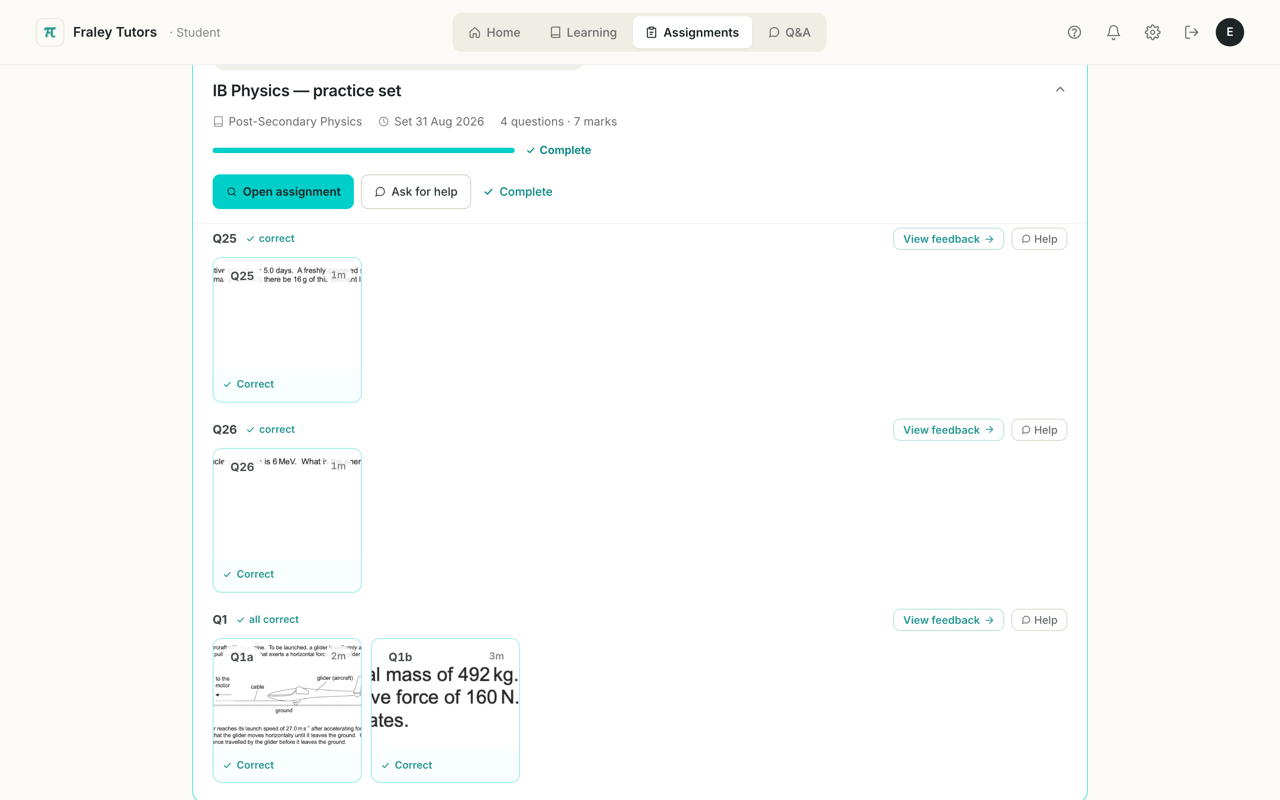
Instantly marked homework, Q&A with your tutor between sessions, and progress tracking — all included. IB students often work across time zones, and our platform is always available. Many of our students take IB Maths with us alongside physics, with the two reinforcing each other.
Full platform access included — instant homework feedback, Q&A support, curriculum tracking. No contracts, no hidden fees.
See Full Pricing DetailsBook a free 20-minute intro meeting. No obligation, no pressure.
Book a Free Intro Meeting