Analysis & Approaches · Applications & Interpretation · SL & HL
Book a Free Intro MeetingIB Mathematics has its own distinctive challenges — here's what we see most often.
Analysis & Approaches HL is typically expected by top UK universities for maths, physics, and engineering. Applications & Interpretation may be accepted for economics, computing, or social sciences at some institutions — but it’s worth checking specific university conditional offer requirements before making the choice. Getting this wrong can close doors before applications begin.
The IA is assessed against five IBO criteria: Communication, Mathematical Presentation, Personal Engagement, Reflection, and Use of Mathematics. The ‘Use of Mathematics’ criterion requires demonstrating mathematical sophistication beyond SL standard for full marks — a topic that sounds interesting but only requires basic maths will not score well, regardless of how well it’s written.
AA HL calculus goes beyond A-Level: Maclaurin series, Euler’s method for differential equations, volumes of revolution, and related rates of change. The Paper 3 component (unique to HL) tests open-ended investigation problems with no fixed method — a format that does not appear anywhere in UK A-Level syllabuses and requires specific preparation.
GDC is allowed in Papers 2 and 3 but not Paper 1. Most IB schools use the TI-84 Plus or Casio fx-CG50. Students need to be fluent with their own calculator model — knowing how to solve equations, find intersections, and perform regressions quickly is the difference between having time to check answers and running out entirely.
The IB assessment structure is distinctive — understanding it shapes how to prepare.
Analysis & Approaches HL runs three written papers: Paper 1 (no GDC, 120 min), Paper 2 (GDC allowed, 120 min), and Paper 3 (GDC allowed, 60 min — open-ended investigation problems). Paper 3 is unlike anything in UK A-Level syllabuses: there is no fixed method, and questions are designed to test sustained mathematical exploration in an unfamiliar context.
AA focuses on pure mathematics: algebra, calculus, trigonometry, proof. AI focuses on modelling, statistics, and real-world applications, with heavier GDC use. AI HL includes topics like Markov chains, complex regression, and graph theory. Neither route is simply ‘easier’ than the other — they test different mathematical strengths.
The IA is worth 20% of the final grade and is externally moderated by the IBO. It’s a 12–20-page mathematical exploration assessed against five criteria. Unlike exam performance, the IA mark is largely determined before the exams. Topic choice, structure, and the level of mathematics demonstrated all affect the final score significantly.
Paper 1 for both AA and AI courses is non-calculator. This paper tests whether students can perform exact calculations, recognise exact values of trigonometric functions, and manipulate algebra without digital assistance. Students who have relied on GDC throughout the year often find Paper 1 the most demanding of the three — it rewards fluency that must be built deliberately.
Our tutors understand the IB system — many studied internationally or sat IB exams themselves.
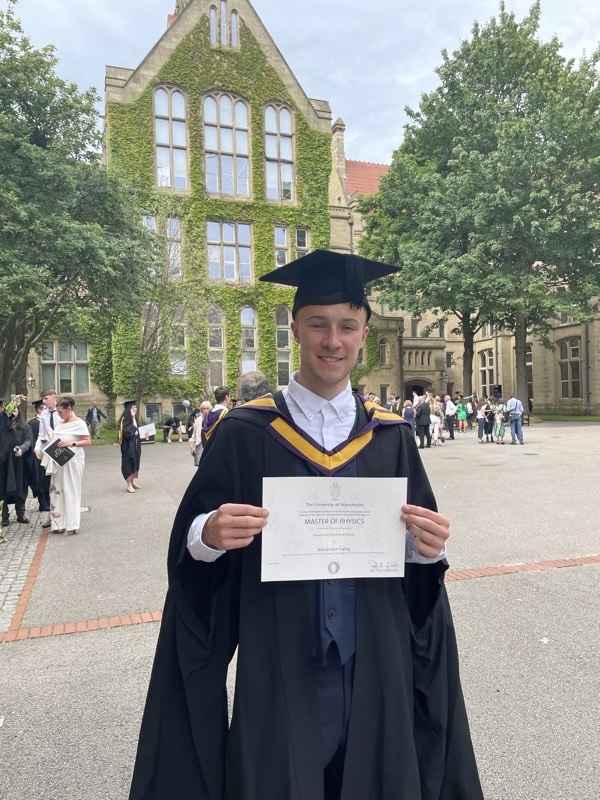
Our IB Maths tutors are university maths and physics students who understand the IB curriculum deeply. They've worked with IB students across Europe and the UK.
We help students choose a topic that will score well on the ‘Use of Mathematics’ criterion, structure their exploration against the five IBO marking criteria, and present mathematical reasoning clearly. A well-chosen topic with good structure regularly outscores a sophisticated topic that is poorly presented.
IB Maths Papers 1 and 2 reward clear reasoning, not just correct answers. Marks are sometimes awarded for method even when the final answer is wrong — students who show their working systematically can recover marks in a way that students who only write the answer cannot. We train students to write their solutions in the way IB mark schemes reward.
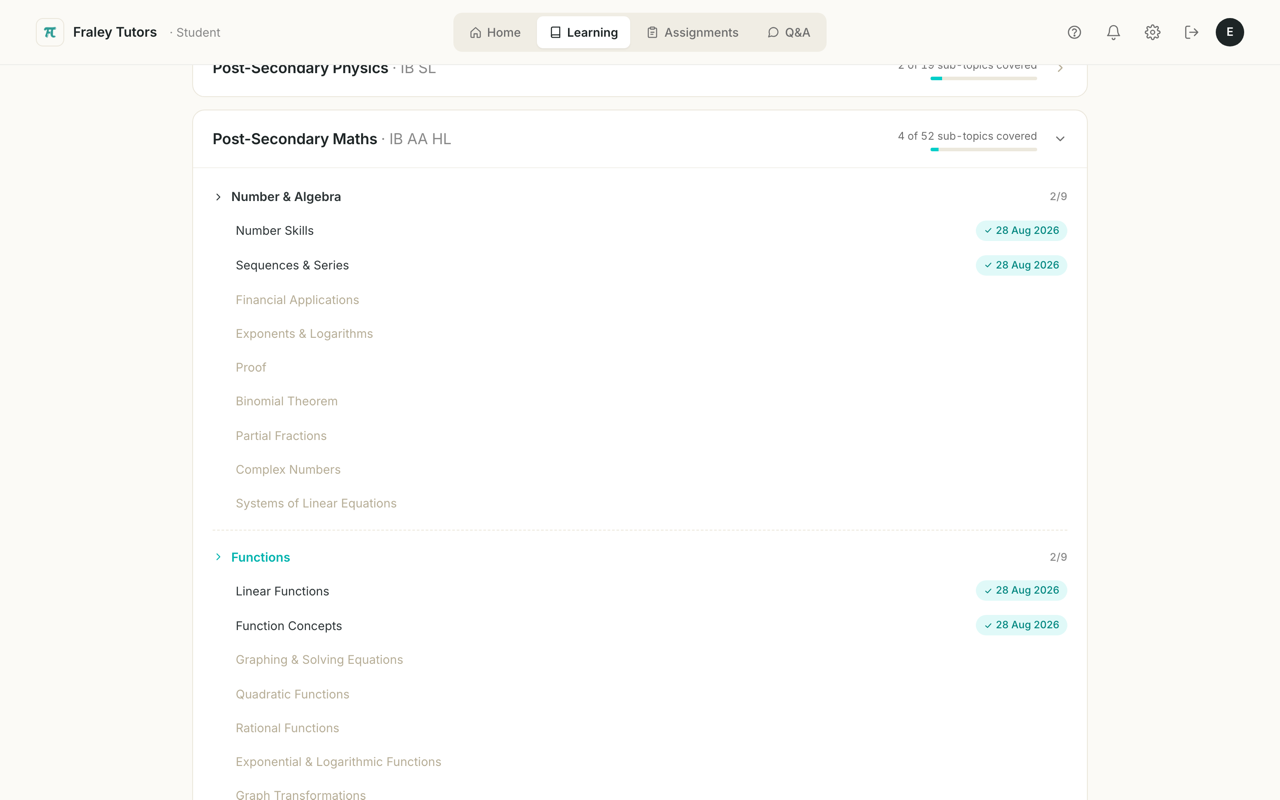
Instantly marked homework, Q&A with your tutor between sessions, and progress tracking — all included. IB students often study in different time zones, and our platform is always available.
Full platform access included — instant homework feedback, Q&A support, curriculum tracking. No contracts, no hidden fees.
See Full Pricing DetailsBook a free 20-minute intro meeting. No obligation, no pressure.
Book a Free Intro Meeting