AQA · Edexcel · OCR — Combined & Triple Science, Foundation & Higher
Book a Free Intro MeetingPhysics is where the maths of GCSE meets ideas that have to be pictured before they can be calculated. These are the sticking points we hear about most.
At least 30% of the marks in GCSE Physics test mathematical skills — more than chemistry or biology. Students have to rearrange formulae, work in standard form, convert units, and read values off graphs, often inside a question that is really about a physics idea. A student who is shaky on the maths from GCSE Maths will lose physics marks that have nothing to do with not understanding the physics.
Every board sets a fixed list of required practicals — specific heat capacity, resistance, force and extension, waves, and more. They are not assessed by coursework: they reappear in the written papers, where examiners ask about the method, the variables, the sources of error, and how the apparatus was used. Students who did the experiments but never revised them are repeatedly caught out.
GCSE Physics involves a long list of equations, and on most boards some are given while others must be recalled from memory. The harder skill is choosing which equation a worded problem actually needs, then carrying units correctly through a two- or three-step calculation. Knowing the formula is not the same as knowing when it applies.
Each paper carries extended-response questions marked by levels, not tick-boxes. To reach the top level a student has to give a connected, logical explanation in the right order, using correct terminology — describing forces, energy transfers, or wave behaviour as a chain of cause and effect. Students who write a list of true statements with no link between them stall at the middle level however much they know.
GCSE Physics comes in two routes and two tiers, and the boards differ — knowing which applies to your child shapes how to prepare.
Physics is assessed entirely by two written papers. Paper 1 covers energy, electricity, the particle model, and atomic structure; Paper 2 covers forces, waves, magnetism and electromagnetism. Both mix one-mark recall, structured calculation, and extended response in the same paper, so students have to switch between answer styles question by question.
Foundation tier targets grades 1–5 and Higher tier grades 4–9, with overlapping content at grades 4 and 5. Higher papers add harder calculations and Higher-only material. Choosing the right tier matters: a student capable of a grade 7 must sit Higher, while entering a borderline student for Higher when Foundation would secure the grades they need is a common, avoidable mistake.
Most students meet physics inside Combined Science, where it makes up part of a double award; others take separate (Triple) GCSE Physics for a full grade of its own. Triple covers everything in Combined plus extra content — space physics, the life cycle of stars, red shift, and more — and is the better foundation for A-Level. The route changes both how much content there is and how deep it goes.
AQA is the most widely sat board; Edexcel (Pearson) and OCR (Gateway and Twenty First Century) are also common. The physics is the same, but the equation sheets, the named required practicals, and the house style of the questions differ. Practising from the board a student actually sits — rather than whichever past papers come to hand — is a real and easily missed advantage.
Our physics tutors teach the subject as a way of thinking, not a set of formulae to memorise.
Our GCSE Physics tutors are studying physics, engineering, or maths at top UK universities. They use these ideas every day and recently sat the same exams, so they know exactly which bits trip students up and how to make them click.
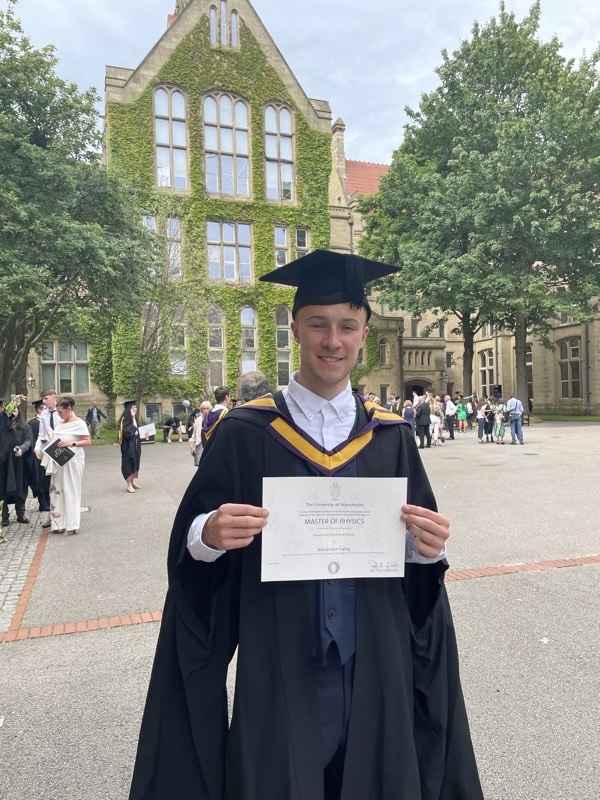
Fraley Tutors was founded by Alex Fraley, who is completing his PhD in theoretical particle physics at the University of Manchester and holds a Distinction in Part III Mathematics from Cambridge. Physics runs through everything we do.
Because so many physics marks are really maths marks, we close the gaps in rearranging, units, and standard form alongside the physics — so a calculation question never costs marks for the wrong reason. It is also the groundwork that makes A-Level Physics a realistic next step.
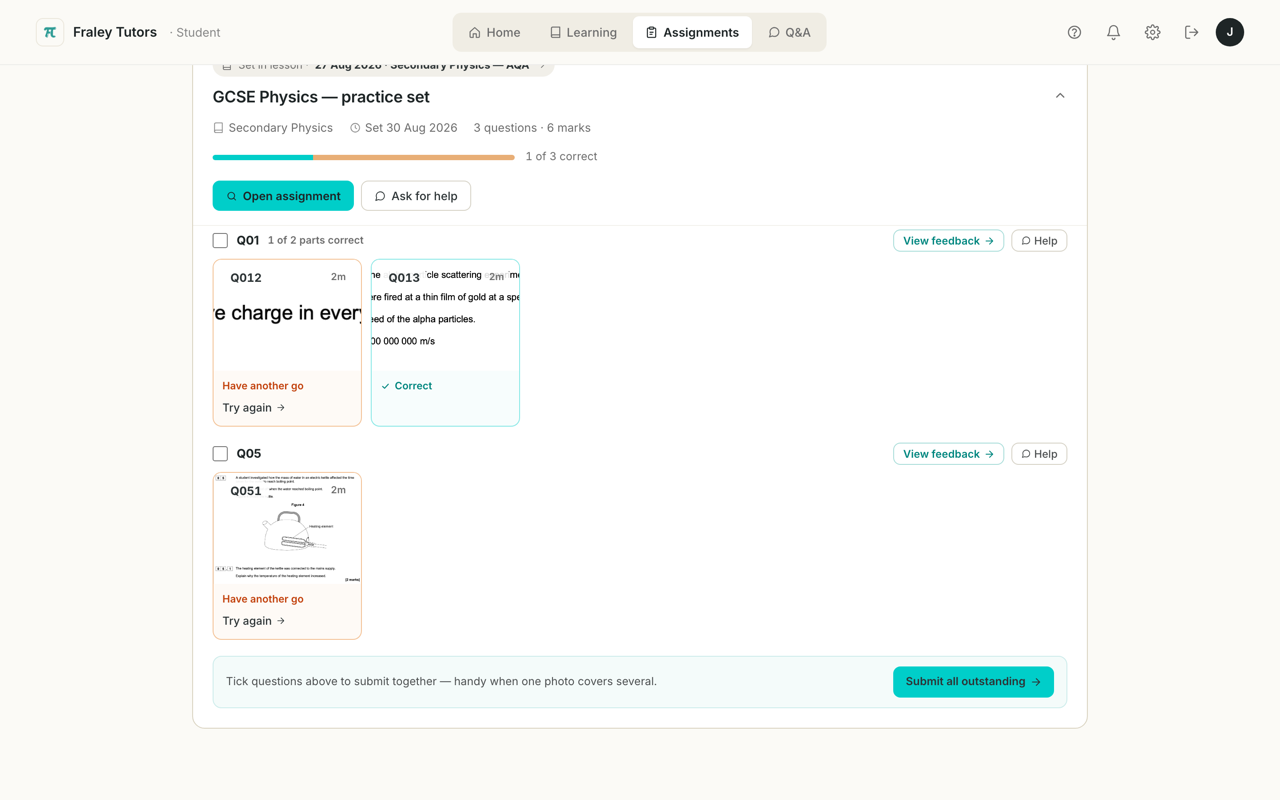
Between lessons, students submit work through our platform and get instant, detailed feedback on their working and reasoning. It reinforces the lesson and catches misunderstandings — a wrong equation, a dropped unit — before they harden into habits.
One simple price, everything your child needs to succeed.
Every lesson includes full platform access: instant homework feedback, curriculum tracking, lesson resources, and Q&A support between sessions. No hidden fees, no signup costs.
See Full Pricing DetailsBook a free 20-minute intro meeting. No obligation, no pressure.
Book a Free Intro Meeting