These are the problems we hear about most from parents and students.
GCSE Higher tier algebra goes well beyond solving equations — it includes factorising non-monic quadratics, manipulating algebraic fractions, solving simultaneous equations graphically and algebraically, and completing the square. These topics appear on AQA, Edexcel, and OCR Higher papers, and they build directly on GCSE Foundation knowledge that many students have gaps in.
Circle theorems are Higher-only content and appear regularly as 3–4 mark questions on all three boards. Students must not only know the eight standard theorems but also explain their reasoning using the correct notation. ‘Knowing the rule’ and ‘writing a valid geometric proof’ are two different skills, and examiners mark the latter.
Since the 2017 reform, AQA, Edexcel, and OCR all increased the proportion of reasoning and problem-solving marks. A student who can apply a method in class may still freeze when that same method is embedded in an unfamiliar context or a multi-step question with no signposting. This gap is where exam technique matters most.
GCSE examiners regularly set 4–5 mark questions that require combining two or three separate mathematical ideas without any indication of which to use. A student who knows all the individual methods but can’t connect them will lose marks on these questions at every sitting, regardless of the board.
The structure of GCSE Maths papers differs by board — knowing yours shapes how to prepare.
AQA, Edexcel, and OCR all run three papers: Paper 1 is non-calculator; Papers 2 and 3 allow a scientific calculator. Paper 1 tests fluency in written arithmetic and algebra without digital assistance — students who rely on a calculator in class routinely drop marks here. Speed and accuracy on Paper 1 is something that needs specific practice, not just general revision.
Foundation tier (grades 1–5) and Higher tier (grades 4–9) share some content at grades 4 and 5, but Higher adds surds, algebraic proof, sine and cosine rules, vectors, circle theorems, and more. A student aiming for grade 7 or above should be on Higher and needs to cover all Higher-only content — which takes up more of the paper than many students realise.
AQA is the most common board in England; Edexcel (Pearson) is widely used in London and the south-east. Their question styles differ: AQA tends toward longer, multi-step worded problems; Edexcel uses more structured, multi-part questions with guided steps. OCR is less common but increasingly used, with a more concise house style. Preparation should be board-specific.
All three boards reserve a significant proportion of marks for questions that require students to reason mathematically, explain their working, or apply mathematics in unfamiliar contexts. These marks cannot be picked up by rote learning alone — they require practising with exam-style problems, not just exercises from a textbook or past classwork.
Our approach to GCSE Maths is built around what actually works.
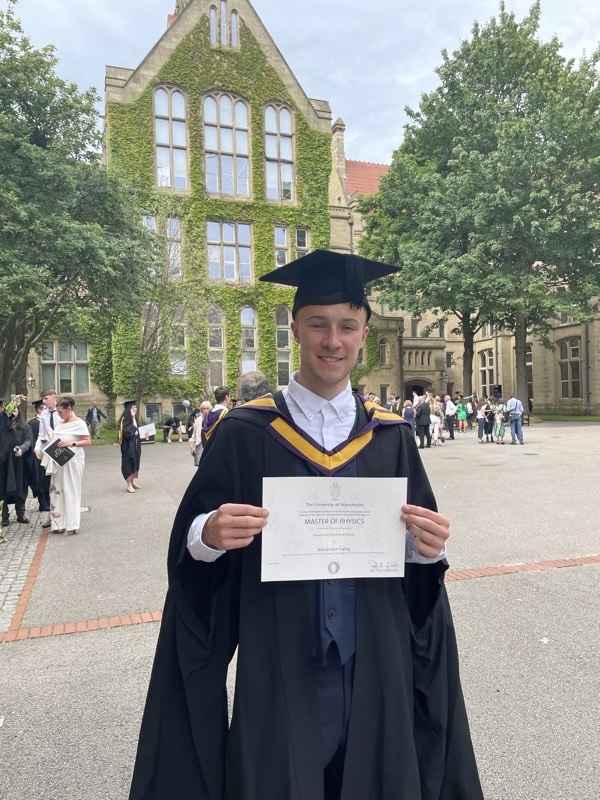
Our GCSE Maths tutors are university maths and physics students who recently sat the same exams. They remember what was hard and know exactly how to explain it clearly.
If the way school taught it didn't click, we try a different angle. Sometimes a five-minute explanation from someone who struggled with the same thing is all it takes.
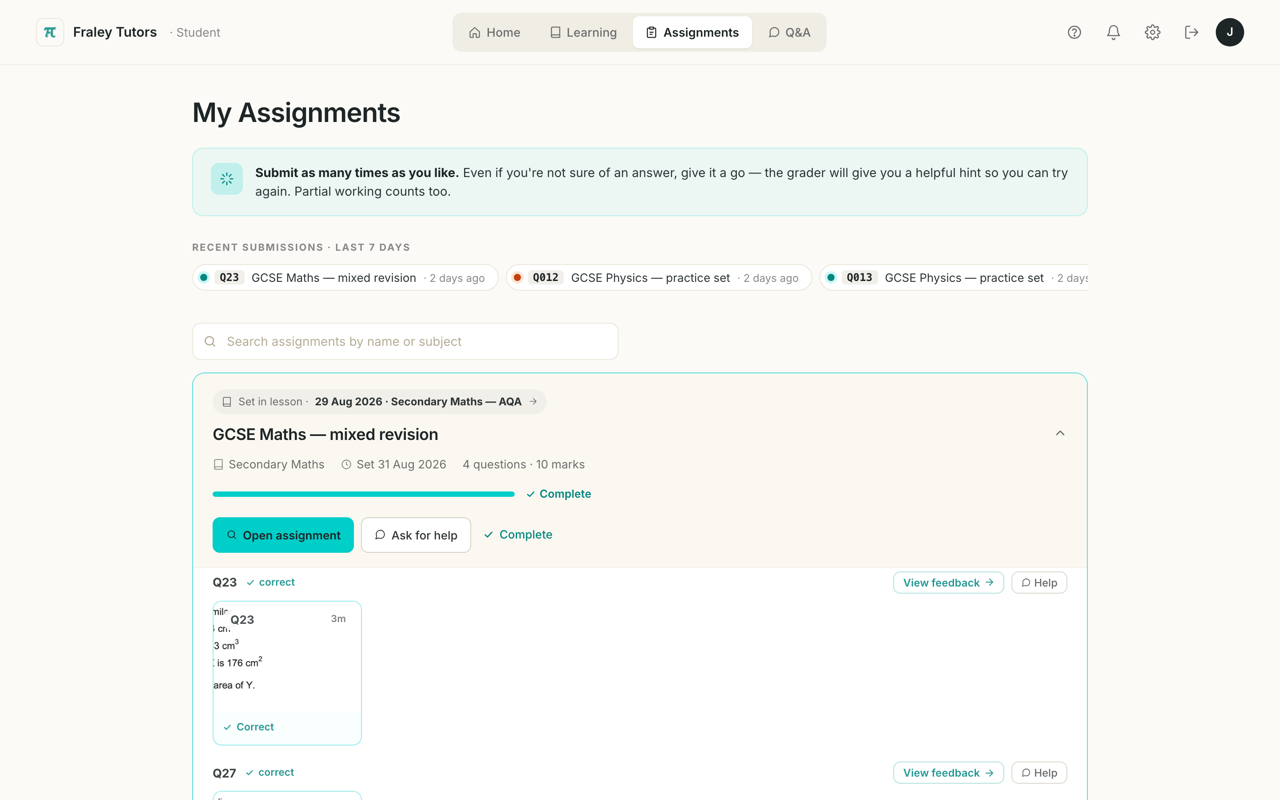
Between lessons, students submit homework through our platform and get instant, detailed feedback on their working. It means they're learning even when the tutor isn't there.
We practise from the right past papers — AQA, Edexcel, or OCR — so students see the exact question styles and formatting their exam uses. Knowing how your board phrases a question is a real advantage; practising from the wrong board’s papers is not the same preparation at all.
One simple price, everything your child needs to succeed.
Every lesson includes full platform access: instant homework feedback, curriculum tracking, lesson resources, and Q&A support between sessions. No hidden fees, no signup costs.
See Full Pricing DetailsBook a free 20-minute intro meeting. No obligation, no pressure.
Book a Free Intro Meeting