Specialist A-Level Further Mathematics tuition · AQA · Edexcel · OCR · OCR MEI
Book a Free Intro MeetingFurther Maths is the most demanding A-Level on offer — a second, harder mathematics qualification taken alongside A-Level Maths, with one of the smallest cohorts of any mainstream subject. The students who take it are aiming high: Cambridge, Imperial, Warwick, and degree courses where the Further Maths grade appears explicitly in the offer.
That's exactly why generalist tuition falls short here. Much of the course — eigenvalues, De Moivre's theorem, second-order differential equations — sits at the edge of university mathematics, and a tutor who is merely comfortable with A-Level Maths will be learning it alongside the student. Our Further Maths tutors study maths and physics at top universities and use this material in their own coursework. Every lesson is private, one-to-one, and online — so the strongest tutor for your board and modules is available wherever you are in the UK.
Further Maths is the most demanding A-Level — here's what makes it hard.
Core Pure 1 opens with complex numbers — including complex roots of quadratics, Argand diagrams, and modulus-argument form. By Core Pure 2, students are working with matrices, eigenvalues, and proof by induction. Each stage builds directly on the last, so gaps in early topics compound quickly as the course progresses.
Further Maths covers Core Pure 1 and Core Pure 2 — which together contain roughly as much new mathematics as the whole of A-Level Maths — plus optional applied modules, all in the same two years. The pace is relentless on every board, and there is no spare time in the schedule for catching up.
Many schools teach Further Maths to small classes with limited staffing, and some students cover parts of the course through self-study or online resources. Either way, the level of per-student support is lower than for other A-Levels — which is exactly when individual tutoring makes the most difference.
Students taking Further Maths are typically applying to competitive courses at Cambridge, Imperial, and Warwick, where the Further Maths grade often appears explicitly in conditional offers. Every mark counts — a student who drops from an A* to an A on Further Maths can miss their university place.
Every board examines the same Core Pure foundation; the optional modules are where boards — and students — diverge.
Complex numbers and Argand diagrams, matrices and linear transformations, roots of polynomials, proof by induction, series, and vectors extended to lines and planes in three dimensions. This is the material every Further Maths student meets first, on every board — and because everything later builds on it, early gaps here are the single most common reason students seek further mathematics help. A tutor who spots and closes those gaps in the first term changes the trajectory of the whole course.
De Moivre’s theorem and roots of unity, hyperbolic functions, polar coordinates, Maclaurin series, further calculus, and first- and second-order differential equations — the most university-adjacent content in any A-Level. (Boards split the core content across papers slightly differently, but the mathematics is the same.) This is where students with a generalist tutor tend to stall, and where ours are most at home: it’s the maths they use in their own degrees.
Extends the core: further calculus, groups, number theory and more, depending on board. The right choice for students aiming at a mathematics degree — it’s the closest the A-Level gets to first-year university pure maths, and the best STEP preparation among the options.
Momentum and impulse, work and energy, elastic collisions, and circular motion. The natural choice for future physicists and engineers — it overlaps heavily with A-Level Physics and with the mechanics that engineering courses assume on arrival.
Continuous random variables, chi-squared tests, and further probability distributions. Suits students heading for economics, data science, or any degree with a serious quantitative component — this is the statistics those courses actually use.
Algorithms, graph theory, and linear programming. A distinct, algorithmic way of thinking that suits students heading for computer science — and the module where exam technique diverges most from the rest of the course.
The structure varies more between boards than in any other A-Level — your tutor works to yours.
The most widely taken board. Two Core Pure papers make up half the A-Level; two optional papers (from Further Pure 1&2, Further Statistics 1&2, Further Mechanics 1&2, Decision 1&2) complete it. Edexcel papers reward clearly structured working — method marks are awarded independently of accuracy marks, so a correct method with an arithmetic slip still earns partial credit.
Compulsory pure content is examined across Papers 1 and 2, with the applied options — mechanics, statistics and discrete maths — sitting in Paper 3. AQA’s pure papers lean on multi-step problems that chain several Core Pure topics together, so fluency moving between complex numbers, matrices and calculus matters more than on any other board.
Two mandatory Pure Core papers plus optional papers from Statistics, Mechanics, Discrete Mathematics and Additional Pure. The Additional Pure option is distinctive to OCR — sequences, number theory and surfaces beyond the shared core — and suits the most mathematically ambitious students.
A mandatory Core Pure paper, a major option in Mechanics or Statistics, and a minor option from a distinctive list including Modelling with Algorithms, Numerical Methods and Extra Pure. MEI integrates mathematical modelling more heavily than other boards — a style of question students need to practise specifically, with a tutor who knows it.
Our tutors study maths and physics at the level that makes Further Maths straightforward for them.
Our Further Maths tutors are studying mathematics and physics at top universities. They use complex numbers, matrices, and differential equations in their own coursework — they teach these topics from genuine understanding, not from a textbook.
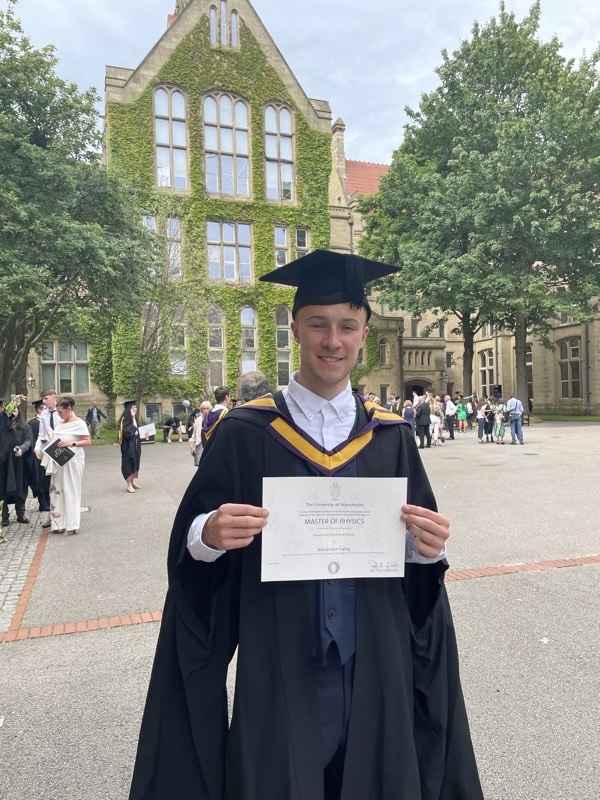
Our founder Alex holds a Distinction in Part III of the Mathematical Tripos at Cambridge — one of the hardest pure maths courses in the world. For Further Maths students, this depth of knowledge matters.
Lessons draw on a large bank of exam-style questions organised by board, module and topic — so a student on Edexcel Further Statistics practises exactly the style of question their papers will ask, not generic material.
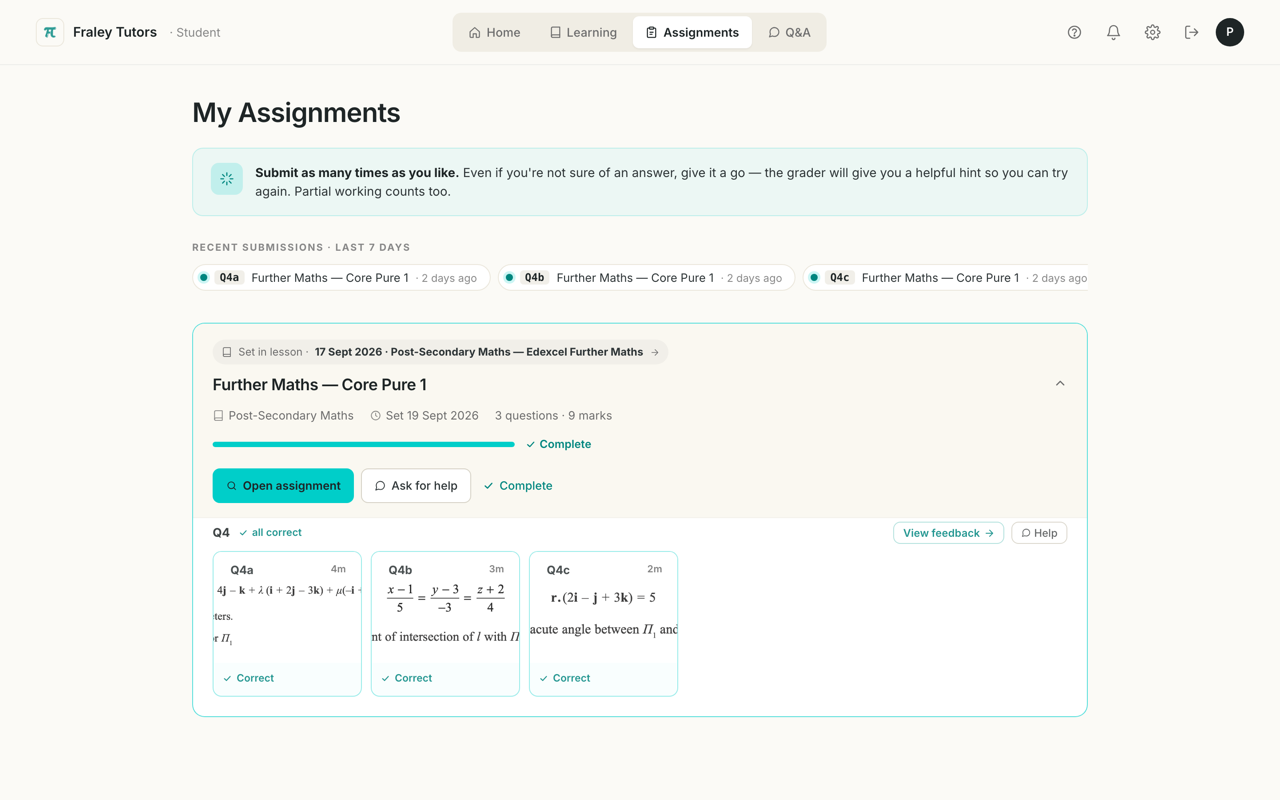
Instantly marked homework, Q&A with your tutor between lessons, and progress tracking — all included. Further Maths students benefit most from consistent support outside the weekly lesson, because the course moves too fast to save every question for next week.
For most of our Further Maths students, STEP, MAT or TMUA preparation runs alongside the A-Level — we teach both together.
STEP 3 is built directly on Further Maths content — complex numbers, hyperbolic functions, differential equations — and STEP 2 assumes the start of the course. If a Cambridge or Warwick offer includes STEP, Further Maths lessons and STEP preparation are the same project, and treating them separately wastes the overlap.
Both officially examine A-Level Maths content rather than Further Maths — but they reward exactly the problem-solving fluency Further Maths builds. Our tutors have sat these exams themselves and know which habits from the A-Level course transfer, and which entrance-exam techniques need practising on their own.
We cover Further Maths and entrance exam preparation with the same tutor, moving lesson focus between the two as term deadlines and exam dates demand — so neither preparation is squeezed out by the other.
How much does a Further Maths tutor cost?
Our rate is £70 per hour — the same standard rate as our GCSE, A-Level and IB tuition — with no contracts and nothing extra to pay. Instantly marked homework, Q&A support between lessons, and progress tracking are all included. See full pricing details.
Which Further Maths exam boards do you cover?
All of them: Edexcel (9FM0), AQA (7367), OCR A (H245) and OCR MEI (H645). Your tutor matches lessons, practice questions and exam technique to your board and your optional modules.
Can lessons cover STEP, MAT or TMUA preparation as well?
Yes. Many of our Further Maths students are preparing for university entrance exams at the same time, and the content overlaps heavily — STEP 3 is built directly on Further Maths material. Lessons can move between the two as deadlines demand, with the same tutor. More on entrance exam tutoring.
My child is the only Further Maths student in their year — can you help?
This is one of the most common situations we see. Small or non-existent Further Maths classes mean students end up effectively self-studying the hardest A-Level. Our tutors provide the structured teaching, marked practice and help between lessons that the school timetable isn’t providing.
How does online Further Maths tuition work?
Lessons are live and one-to-one with your own tutor. Between lessons, students submit homework through our platform — it’s marked instantly with detailed feedback, and your tutor reviews anything the marking system flags — and they can ask their tutor questions whenever they get stuck.
Which optional modules should my child choose?
It depends on where they’re heading. Further Mechanics suits future physicists and engineers; Further Statistics suits economics and data-driven degrees; Decision Maths suits computer science; Further Pure suits students aiming at a mathematics degree. School timetabling sometimes constrains the choice — your tutor will talk through the options in the first lesson.
Do you tutor GCSE Further Maths?
Yes. AQA Level 2 Further Maths (often called GCSE Further Maths) is covered within our GCSE Maths tuition at the same rate — and it’s the best preparation there is for starting A-Level Further Maths.
Our standard rate, the same as GCSE, A-Level and IB tuition. Full platform access, instant homework feedback, Q&A support. No contracts.
See Full Pricing DetailsBook a free 20-minute intro meeting. No obligation, no pressure.
Book a Free Intro Meeting