A-Level Physics Tutoring

AQA · Edexcel · OCR A · OCR B — AS & A2

Book a Free Intro Meeting

Common Challenges at A-Level Physics

Physics demands a unique combination of mathematical skill and conceptual understanding. Here's where students get stuck.

Applying Maths to Physics

A-Level Physics demands more than rearranging equations — it requires knowing which equation applies, what each symbol represents physically, and how units behave through a multi-step calculation. On AQA and Edexcel, questions regularly chain three or four equations in sequence, each with different unit requirements, under timed conditions.

Command Words Have Real Meaning

A-Level Physics examiners use command words precisely: ‘state’ requires a fact, ‘explain’ requires a physical mechanism and cause-and-effect chain, ‘evaluate’ requires a judgment with evidence. Students who answer ‘explain’ questions with correct facts — but no connecting logic — consistently lose marks on AQA and Edexcel, even when they know the physics.

Required Practicals Appear on Written Papers

All boards require students to complete a set of practical experiments that are formally signed off (the Practical Endorsement). More importantly, these same experiments appear in written papers. AQA examiners test understanding of the method, the quantities measured, sources of uncertainty, and how to minimise systematic errors — not just the result obtained.

Structured Argument Under Pressure

Extended-response questions are not just testing knowledge — they test whether a student can organise their thinking into a coherent argument within a few minutes. Students who write in bullet points or list facts without linking them consistently reach only level 2 of 3 on AQA’s level-of-response marking, regardless of how much physics they know.

What This Exam Tests

Four boards, one subject — the structure and marking styles differ in ways that shape preparation.

AQA — Option Topic in Paper 3

AQA A-Level Physics (7408) is the most widely sat board. Three papers: Paper 1 (Measurements, Mechanics, Materials, Waves, Electricity), Paper 2 (Further Mechanics, Thermal Physics, Fields, Nuclear), and Paper 3 (Practical skills plus one option module). The option — Astrophysics, Medical Physics, Engineering Physics, Turning Points in Physics, or Electronics — is chosen by the school and assessed in Paper 3 Section B.

Edexcel — More Quantitative

Edexcel Physics (9PH0) places greater emphasis on vector analysis and quantitative problem-solving than AQA. Papers 1 and 2 cover the core physics content; Paper 3 is a synoptic paper combining practical reasoning with general physics. Students often find Edexcel questions more mathematically demanding but more consistently structured from year to year.

OCR A and OCR B

OCR A follows a structure similar to AQA, with a practical skills paper alongside two content papers. OCR B, Advancing Physics, takes a more conceptual and contextual approach — it rewards students who can apply physics to unfamiliar situations rather than recall specific syllabus content. Students on OCR B benefit from a tutor who knows its distinctive assessment style.

Level-of-Response Marking

Extended-response questions (5–6 marks) use level-of-response marking: three quality levels, not six tick-boxes. To reach the top level, an answer must give a connected, logical account using precise physics terminology. Listing correct facts in the wrong order will reach level 2 at most — the logic and language of the answer matter as much as the physics content.

How We Help

Our physics tutors teach the subject the way it should be taught — with deep understanding at the centre.

Physics Students & Graduates

Our A-Level Physics tutors are studying or have studied physics at top UK universities. They use this maths and these concepts every day, and they know how to make them click for someone seeing them for the first time.

Founded by a Physicist

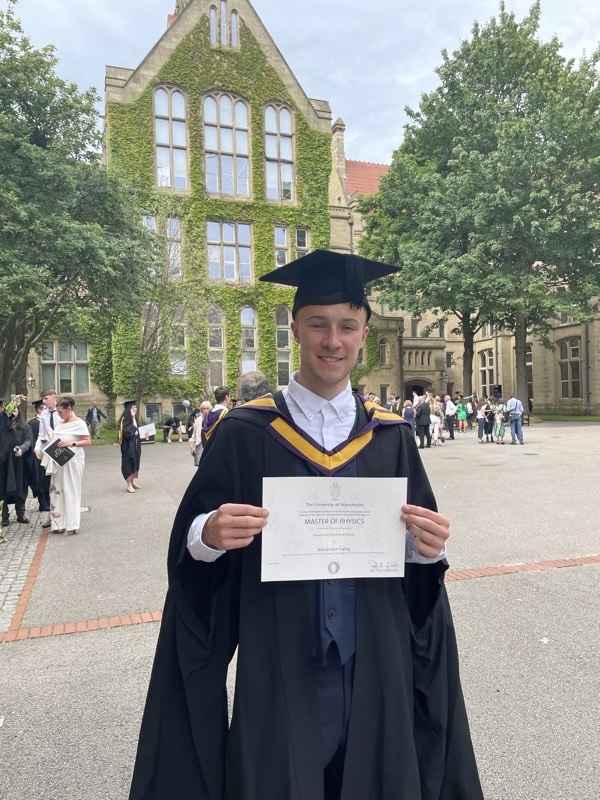
Fraley Tutors was founded by Alex Fraley, who is completing his PhD in theoretical particle physics at the University of Manchester and holds a Distinction in Part III Mathematics from Cambridge. Physics runs through everything we do.

The "Why" Behind Every Equation

We don’t just show students how to apply equations — we explain where they come from and what they represent physically. A student who understands why F = BIl takes the form it does can identify which situations it applies to, spot errors in their own working, and handle the ‘explain’ and ‘evaluate’ questions that separate A from A* on AQA and Edexcel.

Instant Homework Feedback

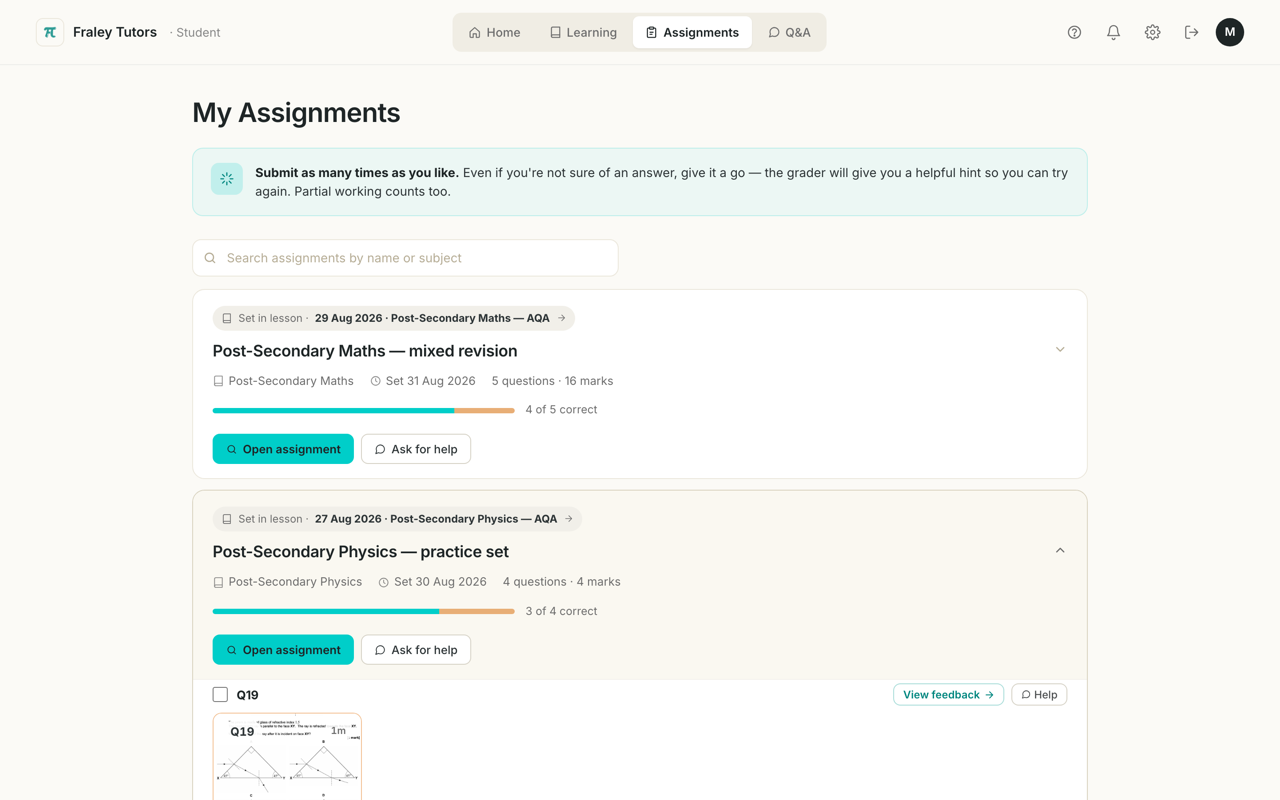
Between lessons, students submit work through our platform and receive instant, detailed feedback on their solutions and reasoning. It reinforces the lesson and catches misunderstandings early.

What's Included

One simple price, everything your child needs to succeed.

£70 / hour

Every lesson includes full platform access: instant homework feedback, curriculum tracking, lesson resources, and Q&A support between sessions. No hidden fees, no signup costs.

See Full Pricing Details

Ready to get started?

Book a free 20-minute intro meeting. No obligation, no pressure.

Book a Free Intro Meeting
Book Free Meeting