A-Level Maths is a significant step up. These are the areas where students most often need help.
AQA and Edexcel both introduce calculus in the first term of Year 12, and it assumes solid GCSE algebra. Students who never fully consolidated surds, indices, and polynomial manipulation at GCSE find the initial gradient very steep — the calculus is new, but the algebra it builds on is supposed to be familiar.
Differentiation from first principles — proving that the derivative of x² is 2x from the limit definition — appears on all three main boards and is a recurring exam question. Students often skip it in favour of the standard rules, then drop 3 marks when it appears in Paper 1 or 2, as it does almost every year.
A-Level Maths covers two full years of entirely new material, and all of it is examined in the same three summer papers. A student who falls two weeks behind in Year 12 will find that the gap compounds — later topics assume earlier ones, and there is no resit-then-move-on structure like GCSE.
AQA and Edexcel both award method marks independently of accuracy marks. A student who sets up the right method but makes an arithmetic error halfway through can still recover several marks — but only if their working is clearly laid out. Students who skip steps or work in their head lose these marks entirely, even when they understand the maths.
All four boards cover the same core content — but the structure and applied emphasis differ in ways that matter for preparation.
Every board runs two Pure papers. Topics include calculus, proof, trigonometry, logarithms, vectors, binomial series, and sequences. Roughly two-thirds of total marks are pure. A strong foundation in calculus and algebra matters more than anything else — on every board, and for every applied question too, since mechanics and statistics questions routinely require calculus.
Edexcel A-Level Maths (9MA0) requires familiarity with a pre-release Large Data Set — real weather data from specific UK and international locations. Paper 3 statistics questions explicitly reference this data, testing whether students can describe patterns, interpret summary statistics, and spot inconsistencies. Students on Edexcel must engage with this data directly, not just revise statistics in the abstract.
AQA Paper 3 combines statistics and mechanics in a single 2-hour paper. OCR offers a choice of mechanics or statistics emphasis in Paper 3. OCR MEI integrates proof and mathematical argument more heavily throughout all papers, even in applied topics — it rewards students who can explain their reasoning in full, not just produce a correct numerical answer.
Mechanics appears in the applied section of every A-Level Maths course: Newton’s laws, kinematics equations (suvat), projectile motion, connected particles, and moments. Many students are surprised by how much physical reasoning it requires — understanding what a diagram represents and which direction is positive matters as much as the calculation.
Our A-Level Maths tutors don’t just explain the method — they build the understanding behind it.
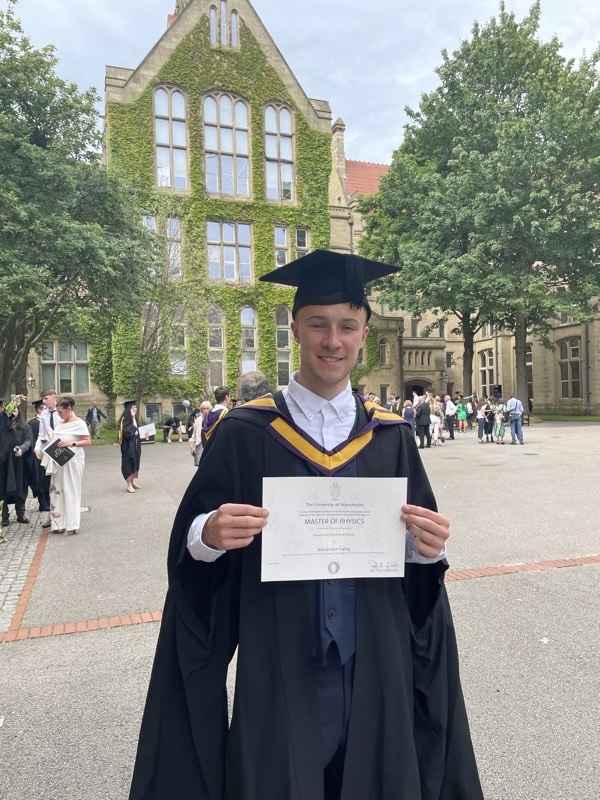
Our A-Level Maths tutors are studying maths, physics, and engineering at leading UK universities. They understand these topics deeply because they use them every day in their own studies.
We identify exactly where a student’s GCSE foundations are shaky and address them before they cause problems. That usually means revisiting surds, index laws, and algebraic fractions — topics that A-Level Maths assumes as prior knowledge but that many students covered once at GCSE and never consolidated.
We teach why methods work, not just how to follow them. A student who understands why integration is the reverse of differentiation can reconstruct the method in an exam rather than just recalling it — which is what AQA and Edexcel reward with their proof and ‘show that’ questions on Paper 1.
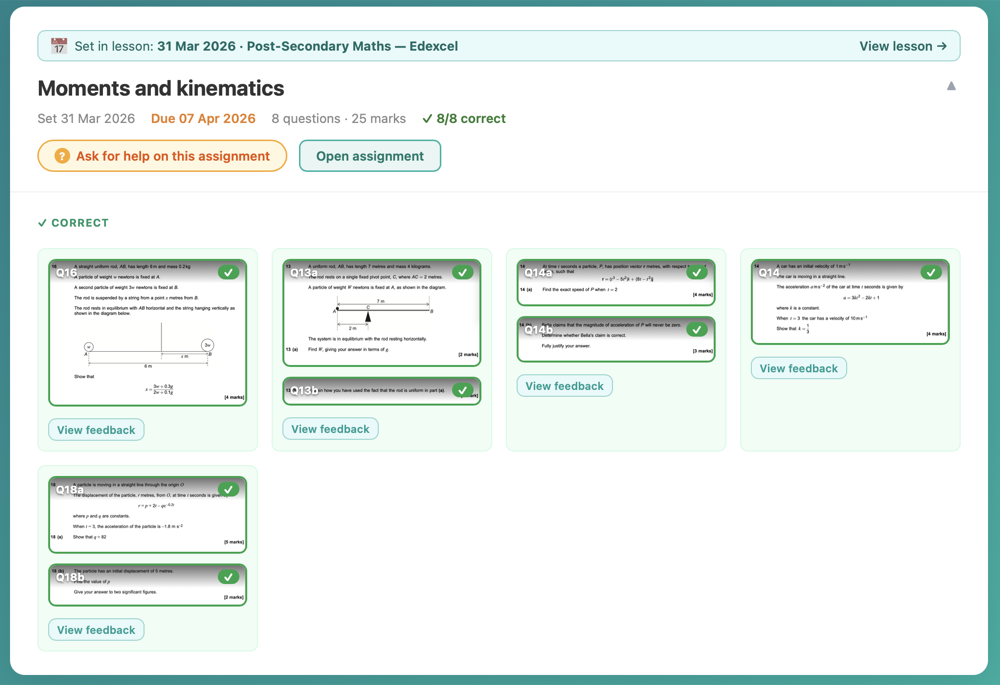
Between lessons, students submit work through our platform and receive instant, detailed feedback on their solutions and working. It keeps the momentum going all week, not just during the lesson.
One simple price, everything your child needs to succeed.
Every lesson includes full platform access: instant homework feedback, curriculum tracking, lesson resources, and Q&A support between sessions. No hidden fees, no signup costs.
See Full Pricing DetailsBook a free 20-minute intro meeting. No obligation, no pressure.
Book a Free Intro Meeting